Culture and science

NASA and space

Astronaut reports, NASA statements and the NASA UAP study team. 138 events, newest first.

1980s

Media

SETI community adopts first post-detection protocol

The International Academy of Astronautics adopted a Declaration of Principles for what to do if a signal from extraterrestrial intelligence is found: verify it first, notify other observers and the UN, announce openly, and send no reply before international consultation.

Media

'Mac and Me' released

Orion Pictures released 'Mac and Me', in which a NASA probe collecting soil on Mars accidentally brings a family of aliens to a California desert lab. The youngest escapes, befriends a boy who uses a wheelchair, and is pursued by federal agents.

Photo: Orion Films, Public domain

Media

SETI Institute founded

Thomas Pierson and astronomer Jill Tarter founded the SETI Institute, a nonprofit to research life beyond Earth. After Congress ended NASA's SETI program in 1993, the institute carried the radio search on with private funds as Project Phoenix.

Photo: Eugene Zelenko, CC BY-SA 4.0

Media

PBS NOVA airs 'The Case of the UFOs'

PBS's NOVA broadcast 'The Case of the UFOs', which its listing presents as a scientific television inquiry sorting genuine reports from fiction and hoaxes. The program drew on film and eyewitness testimony, astronauts among them, and weighed arguments on both sides.

Media

James Oberg publishes 'UFOs and Outer Space Mysteries'

Space engineer and writer James Oberg published 'UFOs and Outer Space Mysteries: A Sympathetic Skeptic's Report' with Donning. Reviewers noted he examined astronaut and space-related UFO stories and hoax photos and concluded the evidence did not convince him.

Photo: RobertoTenore, CC BY-SA 4.0

1970s

Sightings

Skylab reentry fireballs over Western Australia

NASA's Skylab space station broke up on reentry and scattered debris across southern Western Australia. Esperance residents reported sonic booms and several bright orange lights crossing the sky, and recovered fragments are held at the Esperance Museum.

Photo: Rycho626 at English Wikipedia, Public domain

Government

Sen. Proxmire gives NASA's SETI proposal a Golden Fleece award

Sen. William Proxmire gave NASA's proposed radio search for extraterrestrial signals his Golden Fleece award for wasteful spending. The funding was then removed from NASA's fiscal 1979 budget; a House subcommittee held the first congressional SETI hearings that September.

Photo: United States Senate Historical Office, Public domain

Government

NASA issues Information Sheet 78-1 on UFOs

NASA's Information Sheet 78-1 said NASA would answer public UFO inquiries sent to the White House but ran no UFO research program, and would analyze only bona fide physical evidence from credible sources, following its December 1977 reply to the President's science adviser.

Photo: Vargklo at English Wikipedia, Public domain

Sightings

Cosmos 954 nuclear satellite falls over northern Canada

The Soviet reactor-powered satellite Cosmos 954 reentered over western Canada and scattered radioactive debris across the Northwest Territories. Residents of Yellowknife and Hay River described a burning object trailing pieces; a joint U.S.-Canadian search followed. An identified sky event.

Photo: Federal Government of the United States, Public domain

Government

NASA declines White House suggestion to restart UFO research

On July 21, 1977, Frank Press, science adviser to President Carter, wrote to NASA Administrator Robert Frosch proposing a panel to check for significant new UFO findings since the Condon Report. About five months later NASA answered that neither a research effort nor a symposium was justified.

Photo: NASA, Public domain

Sightings

Petrozavodsk phenomenon

Before dawn, residents of Petrozavodsk in Soviet Karelia reported a huge glowing object shedding beams of light for about 10 minutes, and Soviet papers carried the story. Soviet researchers later attributed it to the launch of the Kosmos-955 satellite from Plesetsk.

Photo: Antonio Bonanno from Milan (Italy), Italy, CC BY-SA 2.0

Government

Voyager probes carry the Golden Record

Voyager 2, the first of NASA's two Voyager probes to launch, carried a gold-plated copper record with images, natural sounds, music and greetings in 55 languages, meant to tell any spacefaring finder about life on Earth. Voyager 1 followed weeks later with a copy.

Photo: NASA/JPL, Public domain

Government

Morocco sightings reported in U.S. embassy cable

A U.S. Embassy Rabat cable relayed Royal Gendarmerie reports of a silent, luminous disc or tube seen from Agadir to Fez early on Sept. 19, 1976, and King Hassan II's request for information. A satellite watcher later matched it to a reentering Soviet rocket stage.

Photo: Christian Lambiotte, CC BY 4.0

Government

Viking labeled-release experiment gives a positive reading on Mars

The labeled-release experiment on NASA's Viking 1 lander returned a positive reading for gas released from nutrient-dosed Martian soil. NASA concluded it reflected soil chemistry, not life, after no organics were found; its designer Gilbert Levin long argued it detected life.

Photo: Unknown author, Public domain

Government

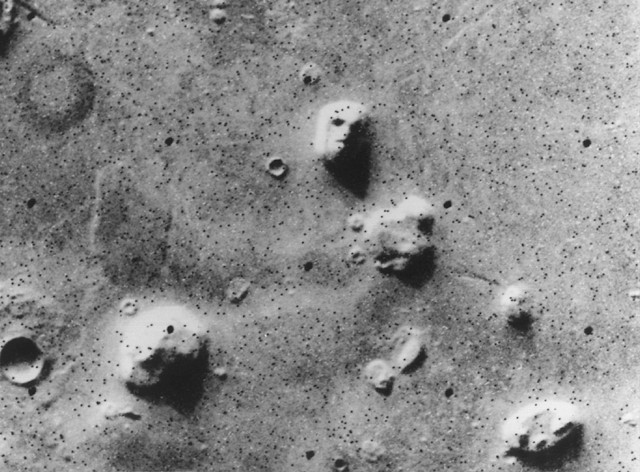
Viking 1 photographs the 'Face on Mars'

NASA's Viking 1 orbiter photographed a mesa in Mars's Cydonia region whose shadows looked like a human face; NASA's 1976 caption called it an illusion. NASA says geologists attribute the landform to natural processes, and Mars Global Surveyor imaged it at ten times the resolution in 1998.

Photo: Viking 1, NASA, Public domain

Media

Ancient-astronaut documentary 'Mysteries of the Gods' with William Shatner

'Mysteries of the Gods', an English version of the West German documentary 'Botschaft der Gotter' based on Erich von Daniken's book Miracles of the Gods, was released in the U.S. in 1976 with William Shatner as host and narrator. Its ancient-astronaut claims are rejected by scientists.

Photo: Michal Manas, CC BY 3.0

Media

NBC airs 'In Search of Ancient Astronauts' with Rod Serling

NBC aired In Search of Ancient Astronauts, a U.S. version of the German Chariots of the Gods documentary narrated by Rod Serling. It promoted von Daniken's ancient-astronaut claims, which scholars regard as pseudoscience, and preceded the In Search of... series.

Photo: CBS Television; portrait by Gabor Rona, Public domain

Government

Pioneer 10 launches with a plaque for extraterrestrials

NASA's Pioneer 10 launched carrying an aluminum plaque showing a man and a woman, the solar system and the Sun's position relative to 14 pulsars, so that any intelligent finder could tell where and when the craft came from.

Photo: Designed by Carl Sagan and Frank Drake . Artwork prepared by Linda Salzman Sagan . Photograph..., Public domain

Government

NASA's Project Cyclops SETI design study

A NASA-sponsored team led by Bernard Oliver, with John Billingham as co-chair, spent ten weeks in summer 1971 designing a large radio array to detect signals from extraterrestrial civilizations. The resulting Project Cyclops report weighed costs, search strategy and signal processing.

Media

Documentary 'Chariots of the Gods' (Erinnerungen an die Zukunft) premieres

Harald Reinl's West German documentary Erinnerungen an die Zukunft, built on Erich von Daniken's ancient-astronaut thesis, premiered aboard a Lufthansa 747 from Frankfurt to New York. Scholars reject the thesis as pseudoscience, yet the film drew an Oscar nomination.

Photo: Michal Manas, CC BY 3.0

1960s

Government

Condon report reviews astronaut UFO sightings

A chapter of the Air Force-funded Condon report, by astronomer Franklin Roach, reviewed what Mercury and Gemini crews saw in orbit. It found most sightings explainable but judged three unexplained: two by James McDivitt on Gemini 4 and one by Frank Borman on Gemini 7.

Photo: National Institute of Standards and Technology, Public domain

Government

House symposium on UFOs

The House Committee on Science and Astronautics held a one-day symposium on UFOs chaired by Rep. J. Edward Roush. Six scientists, including J. Allen Hynek, James McDonald and Carl Sagan, presented views, and further papers were added to the printed record.

Photo: US Congress, Public domain

Media

Erich von Daniken publishes 'Chariots of the Gods?' (pseudoscience)

Swiss writer Erich von Daniken's first book, published in German in 1968 and in English as 'Chariots of the Gods?', argued ancient monuments showed alien visits. It launched the 'ancient astronaut' genre; scientists rejected his claims as contrary to historical and scientific evidence.

Photo: Stephen Jackson, Public domain

Government

Gemini 12 crew sees objects outside the spacecraft, traced to discarded gear

During NASA's Gemini 12 flight, Jim Lovell reported four objects near the capsule and judged they were items the crew had thrown overboard. The Condon study agreed, finding the transcript shows four items were discarded, against claims by writer John Keel that only three were.

Photo: NASA/Jim Lovell, Public domain

Sightings

Gemini 11 crew photographs a tumbling object in orbit

Gemini 11 astronauts Pete Conrad and Richard Gordon reported and photographed a large tumbling object on their 18th orbit. NORAD identified it as the Soviet Proton 3 satellite, and the Condon study's review of the photos suggested several pieces of that launch.

Photo: NASA, Public domain