Tour / 17 stops

Road to the hearings

  1. Stop 1: The Air Force closes its public UFO program, and official interest goes quiet for decades.

    Government

    Blue Book shuts down

    Air Force Secretary Robert Seamans Jr. announced the end of Project Blue Book, citing the Condon study and its review by the National Academy of Sciences. The Air Force said no case it had studied showed a threat to national security or evidence of extraterrestrial vehicles.

  2. Stop 2: Out of public view, the Defense Intelligence Agency funds a study of advanced aerospace threats.

    Government

    DIA awards the AAWSAP contract

    The Defense Intelligence Agency contracted Bigelow Aerospace Advanced Space Studies of Las Vegas for the Advanced Aerospace Weapon System Applications Program, officially a study of future aerospace threats. It produced dozens of technical papers; funding of about $22 million ended in 2012.

  3. Stop 3: The New York Times reveals a Pentagon program and runs Navy videos with the story.

    Media

    AATIP revealed by the New York Times

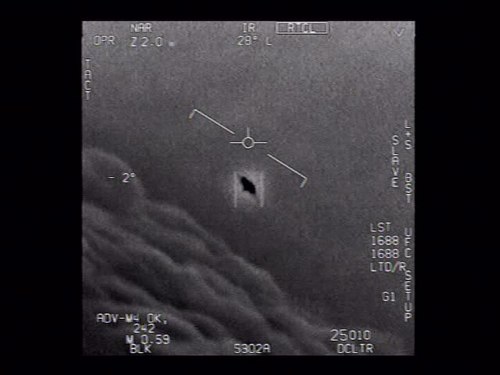
    The New York Times reported that the Pentagon had run a little-known Advanced Aerospace Threat Identification Program, funded with about $22 million from 2008 to 2011. The story ran with two Navy videos and said Luis Elizondo had led the program.

  4. Stop 4: Navy pilots go on the record in the Times about objects seen almost daily off the East Coast.

  5. Stop 5: The Pentagon officially releases the three Navy videos and says the objects remain unidentified.

  6. Stop 6: The Defense Department sets up a Navy-led task force to catalog UAP reports.

    Government

    UAP Task Force formed

    Deputy Secretary of Defense David Norquist approved a Navy-led task force to detect, analyze and catalog UAP that could threaten national security. The Pentagon announced it on August 14.

  7. Stop 7: Intelligence officials deliver their first public assessment to Congress: almost nothing explained.

    Government

    ODNI preliminary assessment

    The Office of the Director of National Intelligence released a preliminary assessment of military UAP reports from 2004 to 2021. It explained one case with high confidence, a deflating balloon, and said limited data left the rest unresolved.

  8. Stop 8: 60 Minutes puts Navy aviators on national television weeks before the intelligence report lands.

  9. Stop 9: Congress writes a permanent UAP office and annual public reports into law.

  10. Stop 10: Congress holds its first open UAP hearing in about half a century.

    Government

    First public UAP hearing in decades

    A House Intelligence subcommittee held an open hearing on UAP with Under Secretary of Defense Ronald Moultrie and Deputy Director of Naval Intelligence Scott Bray, who showed newly declassified video. It was described as the first open congressional hearing on the subject in about 50 years.

  11. Stop 11: A new Pentagon office takes over UAP work with a wider remit.

    Government

    AARO established

    The Defense Department announced the All-domain Anomaly Resolution Office, replacing an earlier group with a wider remit covering air, space, undersea and transmedium objects. Sean Kirkpatrick was named its first director.

  12. Stop 12: A former intelligence officer testifies under oath about claims he says he was told.

    Whistleblowers

    David Grusch testifies

    Former Air Force intelligence officer David Grusch testified under oath that he had been told of a decades-long program to recover craft of non-human origin, which he said he learned through interviews rather than firsthand access. The Pentagon and AARO have said they found no verifiable evidence of such programs.

  13. Stop 13: Senators propose a records-collection law modeled on the JFK files.

    Government

    Schumer-Rounds UAP Disclosure Act introduced

    Senators Chuck Schumer and Mike Rounds filed the UAP Disclosure Act as an amendment to the Senate defense authorization bill. Modeled on the JFK records law, it would have created a UAP records collection at the National Archives and an independent review board.

  14. Stop 14: A narrowed version of the disclosure act becomes law: UAP records go to a new National Archives collection.

  15. Stop 15: AARO's historical review says it found no verifiable evidence of recovered alien technology.

    Government

    AARO historical report

    The Pentagon released volume one of AARO's review of U.S. government UAP efforts since 1945. AARO said it found no verifiable evidence that the government or private companies had recovered or reverse-engineered extraterrestrial technology.

  16. Stop 16: A second House hearing puts four more witnesses under oath.

  17. Stop 17: A House Oversight task force hears more sworn testimony and a member shows a video filmed off Yemen.

    Government

    House Oversight task force UAP hearing

    Rep. Anna Paulina Luna's House Oversight task force heard sworn testimony from Navy and Air Force witnesses and journalist George Knapp. Rep. Eric Burlison showed a video he said was filmed off Yemen in October 2024 of a Hellfire missile apparently failing to down an object.